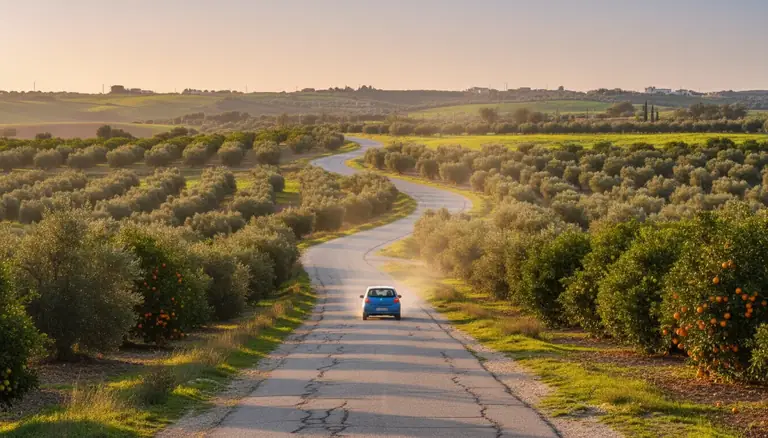
Driving in Tunisia: Rules, Tips & Road Guide
In Tunisia you drive on the right, with limits of 50/90/110 km/h and cheap cash-only A1 tolls; here is what rental drivers need to know about roads, fuel and checkpoints.
Search & Compare Car Rental Deals
Free cancellation on most vehicles
Tunisian Driving Rules at a Glance
Driving in Tunisia is generally straightforward but rewards active attention. Traffic moves on the right and you overtake on the left. For the wider picture on agencies, prices and pickup, the main Hammamet car rental guide is a good starting point, and it pays to compare rental cars for the class that suits your itinerary.
The golden rule of Tunisian roundabouts: vehicles already inside the circle normally have the right of way. Watch for local drivers who enter without yielding, and approach every roundabout ready to slow down.
Seatbelts are mandatory for both front and rear passengers, and handheld phone use is banned while driving (hands-free is fine). Young children should ride in the back in a suitable seat. Tunisia's drink-drive limit is low and strictly enforced, so the safe rule is simply not to drink and drive.
| Road Type | Typical Speed Limit | Key Notes |
|---|---|---|
| Towns & built-up areas | 50 km/h | Watch for sudden speed bumps and pedestrians |
| Open & national roads | 90 km/h | Single carriageways with mixed farm and transport traffic |
| Autoroute (A1 motorway) | 110 km/h | Drops to around 90 km/h in rain or wet weather |
The A1 Autoroute, Tolls and National Roads
The modern A1 autoroute is a well-maintained toll motorway linking the main coastal hubs of Tunis, Hammamet, Sousse and Sfax. It has bilingual Arabic and French signage and regular service stations, which makes it the easiest and safest base for scenic day trips around the region.
Tolls on the A1 are very cheap, but booths usually do not accept foreign credit cards. Keep some Tunisian Dinar (TND) coins or small banknotes within easy reach in the driver's console for the barriers.
By contrast, the national 'GP' roads are toll-free but noticeably slower. These routes pass through towns, feature numerous roundabouts, and mix fast cars with slow scooters and rural farm equipment. Whenever the autoroute runs parallel, it is usually worth the small toll for the time and stress it saves.
Fuel: Prices, Stations and Paying
Fuel in Tunisia is state-subsidised and priced the same across the whole country, so there is no need to shop around. Expect to pay around 2.5 TND per liter for unleaded petrol (essence sans plomb 95) and about 2.2 TND per liter for diesel (gasoil sans soufre).
- Agil (the state-owned national distributor)
- TotalEnergies
- Shell
- Ola Energy (formerly OiLibya)
Larger stations in towns and along the main highway routes often take international cards, but many rural pumps are cash-only. It is also worth checking the sticker inside the fuel filler flap of your rental car to confirm the correct fuel type before filling up.
Hazards, Night Driving and Checkpoints
Tunisian roads reward alertness. Watch for pedestrians stepping off the kerb, weaving mopeds in town traffic, and sudden unmarked speed bumps (locally called 'dos d'ane') at village entrances. If you are collecting a car at Enfidha Airport, driving straight to Hammamet on the A1 is the smoothest way to skip most local hazards.
Driving on rural roads after dark is best avoided. Many secondary routes have no street lighting, and you may meet unlit carts, livestock or deep potholes that are hard to spot in time.
Police and National Guard checkpoints are a routine sight, especially near tourist zones and toll booths. Slow down, stop if signalled, and stay polite; officers normally wave tourists through quickly, but you must carry the proper original documents.
- Your original domestic driver's licence
- A 1968 International Driving Permit (IDP)
- Your original physical passport (photocopies or phone scans are not accepted)
- The rental contract and vehicle registration papers
Parking and What to Do After an Accident
Urban parking is signalled by kerb colors: blue-and-white means paid parking, solid white is free, and red-and-white means no parking. Because even a minor scrape can affect your deposit, it is worth reviewing the insurance and excess rules before you set off so you know exactly what is covered.
Around busy historic sites like the Hammamet Medina, on-street parking is tight. Use a lot watched by local attendants ('gardiens'), who will keep an eye on your car for a small tip of around 1 to 2 TND.
For a minor bump, drivers usually complete a joint European-style accident report (constat amiable). For anything more serious or disputed, the safe rule is to leave the vehicle where it stopped, call the emergency services, and contact your rental agency at once, since a police report is often needed for the damage waiver to apply.
- Police: dial 197
- National Guard (rural highways): dial 193
- Ambulance (SAMU): dial 190
- Civil Protection / Fire: dial 198
Frequently Asked Questions
Which side of the road do you drive on in Tunisia?
Do I need an International Driving Permit (IDP)?
What are the speed limits on Tunisian roads?
Is it safe to drive at night outside cities?
What should I do if I have an accident?
Ready to compare car rental deals in Hammamet?
Check live prices and availability from local and international suppliers.
Compare car rental deals